AOPS Pre-Algebra Chapter 1.3 Notes & Problems - Multiplication
Table of Contents
Key points
Commutative property of multiplication
Let a and b be numbers. Then
$$ab = ba $$
Associative property of multiplication
Let a, b, and c be numbers. Then
$$(ab)c = a(bc)$$
Multiplication by 1
Multiplication by 1
Let a be a number. Then
$$1a = a$$
Order of operations
What's the order of operations?
- Evaluate expressions inside parentheses
- Compute powers
- Multiply and divide from left to right
- Add and subtract from left to right
Distributive property of multiplication over addition
$(b + c) \times a = b \times a + c \times a$
or
Let a, b, and c be numbers. Then
$a(b + c) = ab + ac$
and
$(b + c)a=ba + ca$


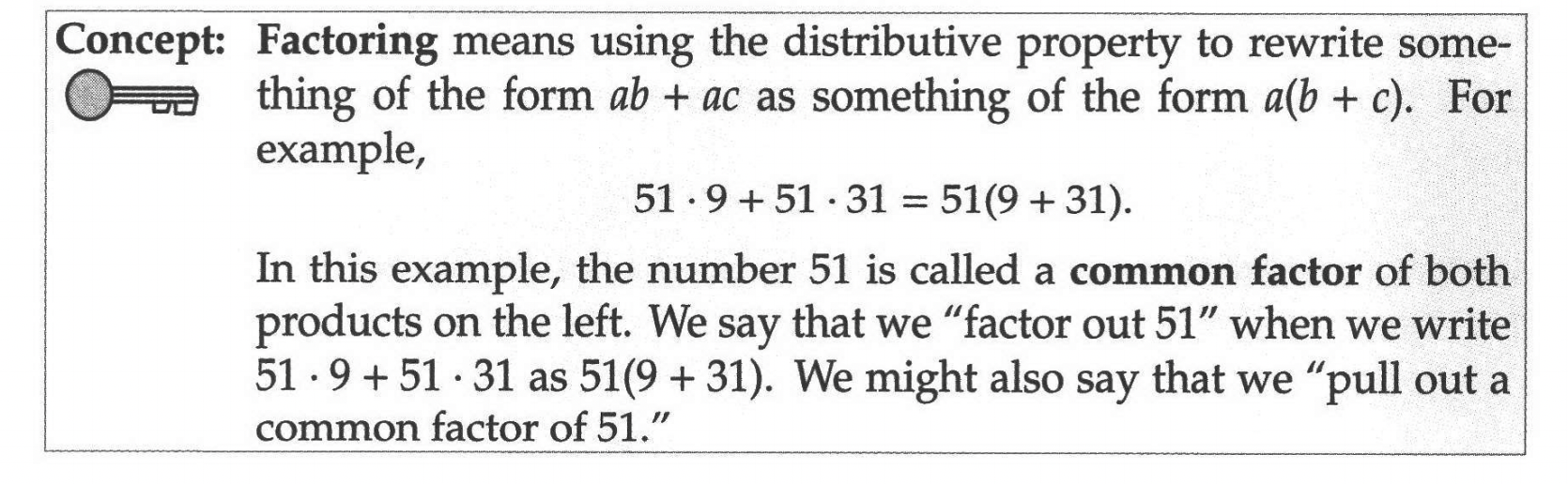
Distributive property and number of products
The distributive property works for a sum of any number of products. For example, if a, b, c, d, and e are any numbers, then:
$$ab + ac + ad + ae = a(b + c + d + e)$$
Similarly, we have
$$ba + ca + da + ea = (b + c + d + e)a$$
Distributive property and repeated addition
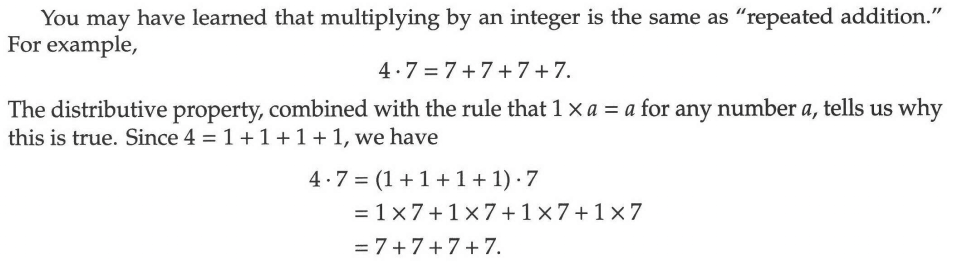
My comment: So we initially rewrite the 4 as 4 1's, and then we distribute out the 7 to the 1's using the distributive property, and then we use the principle of $1 \times a = a$ to turn each $1 x 7$ into a 7, and then we get repeated addition.
Multiplying by zero
Let $x$ be a number. Then
In-Chapter Problems
✅ Problem 1.7
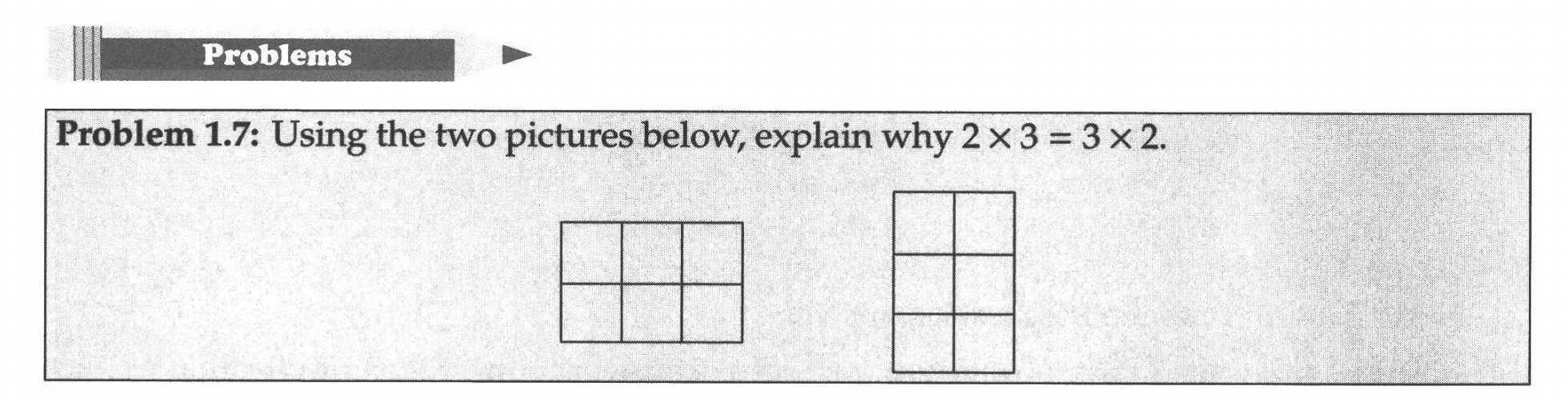
You can think of 2 * 3 as being represented either by a rectangle with 3 columns and 2 rows or boxes, or a rectangle with 2 columns and 3 rows of boxes. One rectangle is just a transformation (rotation) of the other and the same number of boxes are represented in either case.
The book mentions that this problem illustrates the commutative property of multiplication.
✅ Problem 1.8
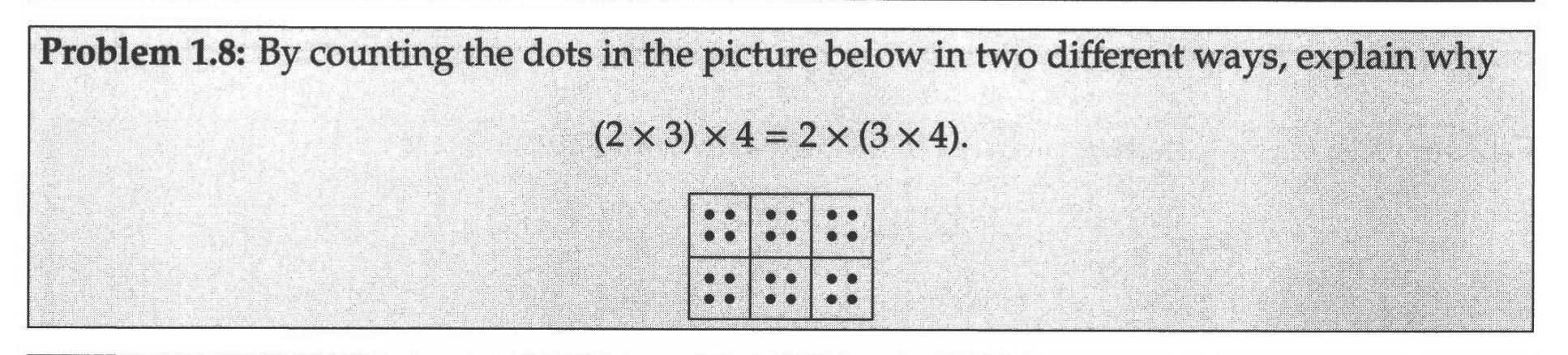
We can think of multiplying by counting up the number of rows and multiplying that by the number of columns, and then multiplying that by the number of dots in each square - this is $(2 \times 3) = 4$. Alternatively, we can think of multiplying by counting up the number of docs in each square, then multiplying that by the number of columns, and then the number of rows - this is $2 \times (3 \times 4)$. Either way, there is no actual change to the result, because in both cases, we are dealing with the same number of rows, columns, and dots in each square, and so we should get the same shape at the end of the day, and also the same result (we can also imagine e.g. $3 \times (2 \times 4)$, which we might represent with an "upright" rectangle of 2 columns and 3 rows, like one of the pictures in Problem 1.7).
The book mentions that this problem illustrates the associative property of multiplication.
✅ Problem 1.9

We can make this problem easier with grouping and rearranging.
$(25 \times 4) \times (125 \times 8) \times 6$
$100 \times 1000 \times 6$
Answer: $600,000$
✅ Problem 1.10
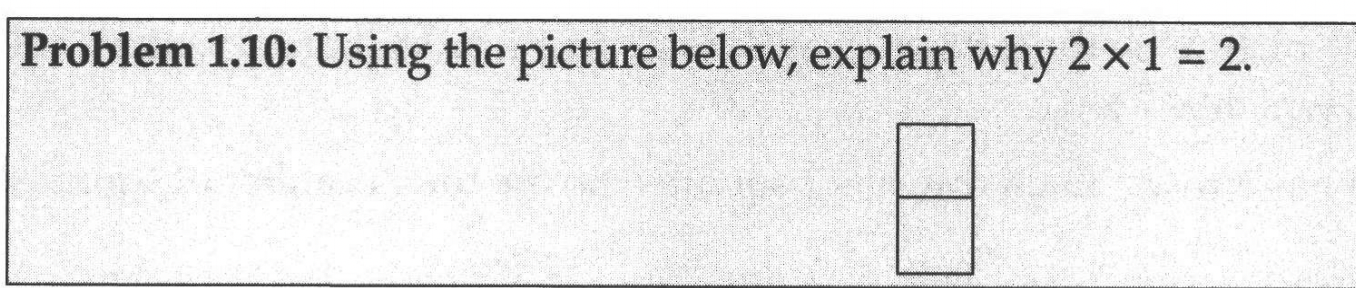
If the above was 2 x 3, we might represent it as a rectangle of 2 rows and 3 columns. But since it's 2 x 1, we only need 1 column. Any number times 1 is going to be itself, and so you only need the one "copy" of the number, which you can visually represent as 1 row or 1 column with a number of boxes equal to that number.
Their explanation:
On one hand, there are 2 rows. Each row has 1 square. So there are 2 x 1 squares in all. On the other hand, there are 2 squares. So we conclude that 2 x 1 = 2.
✅ Problem 1.11
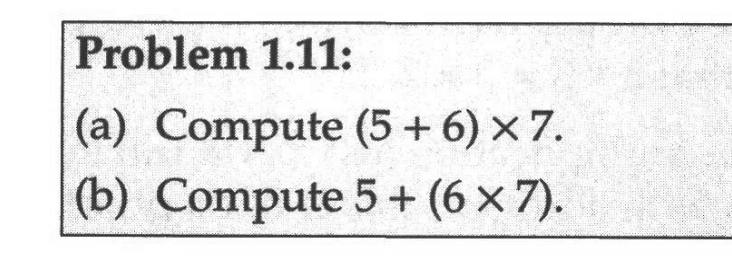
a) $(5 + 6) = 11$. $11 \times 7 = 77$.
b) $(6 \times 7) = 42. 42 + 5 = 47.$
Why'd they come out different, despite having the same numbers and operators from left to right?
The grouping caused a big difference in what we actually calculated. In part a, we first want to determine the value of the grouping 5 + 6, which is 11, and then we multiply that by 7. So we wind up figuring out what 7 groups of 11 is, which is 77. OTOH, with part b, we figure out what 7 groups of 6 is, and that's 42, and then we add 5 to that. So we're asked to do mathematically different things.
This shows that you can't mix operations and expect the same properties to apply as when you just have one operation.
✅ Problem 1.12

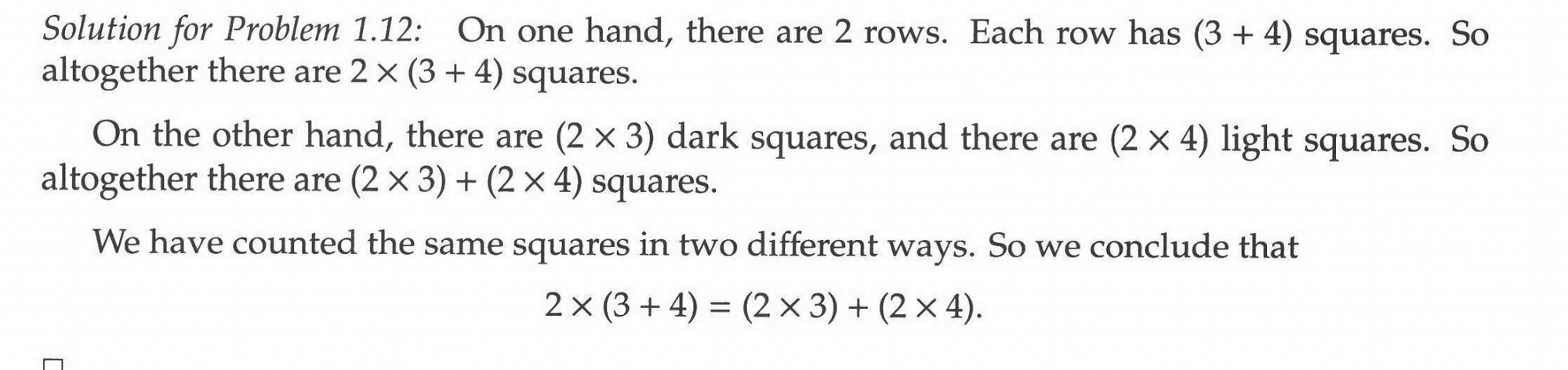
There are at least a couple of ways of thinking about the mathematical operations represented by $2 \times (3 + 4)$. One way is that you are adding up the stuff in the parentheses - namely 3 and 4 - and getting 7, and then multiplying 7 by 2. So there are two operations, and those two operations are represented by the two operators in $2 \times (3 + 4)$. On the other hand, you can think of things in terms of performing two separate multiplication operations - multiplying 2 by 3 and 2 by 4 - and then summing the result. So you have three different operations, and this is represented by the three operators expression $(2 \times 3) + (2 \times 4)$.
One way of thinking about why these come out the same is this - take the expression $2 \times (3 + 4)$. If we follow the order of operations, we get 7. But what is 7? In this context, it's the sum of 3 + 4. So we have a 3 and a 4 that compose this 7, and then we multiply by 2. So what to do we have? One (correct) answer is 14, but another answer is that we have two 3's and two 4's - 6 and 8, respectively, which sum to 14. The 6 is represented by the shaded area, and the 8 is represented by the white area. We can see, then, that the left side of the equation has the same mathematical meaning as the right side, which expressly represents the values in terms of groupings of 3's and 4's.
Their explanation:
✅ Problem 1.13

51 is common to both the expression on the left - 51 * 9 - and the expression on the right - 51 * 31. So we can factor the 51 out and create a simpler mathematical operation to deal with:
$51 \cdot (9 + 31)$
$51 \cdot 40$
Answer: $2040$
Their answer: they explicitly mentioned using the distributive property, and in addition to adding up 9 and 31, they also broke up 51 into 50 and 1:

✅ Problem 1.14

We can factor out the 13.
$13 \cdot (17 + 51 + 32)$
$13 \cdot 100$
Answer: 1300
Their explanation:
They went more step by step. They first factored out 13 from two products:

And then they repeated the process.

✅ Problem 1.15
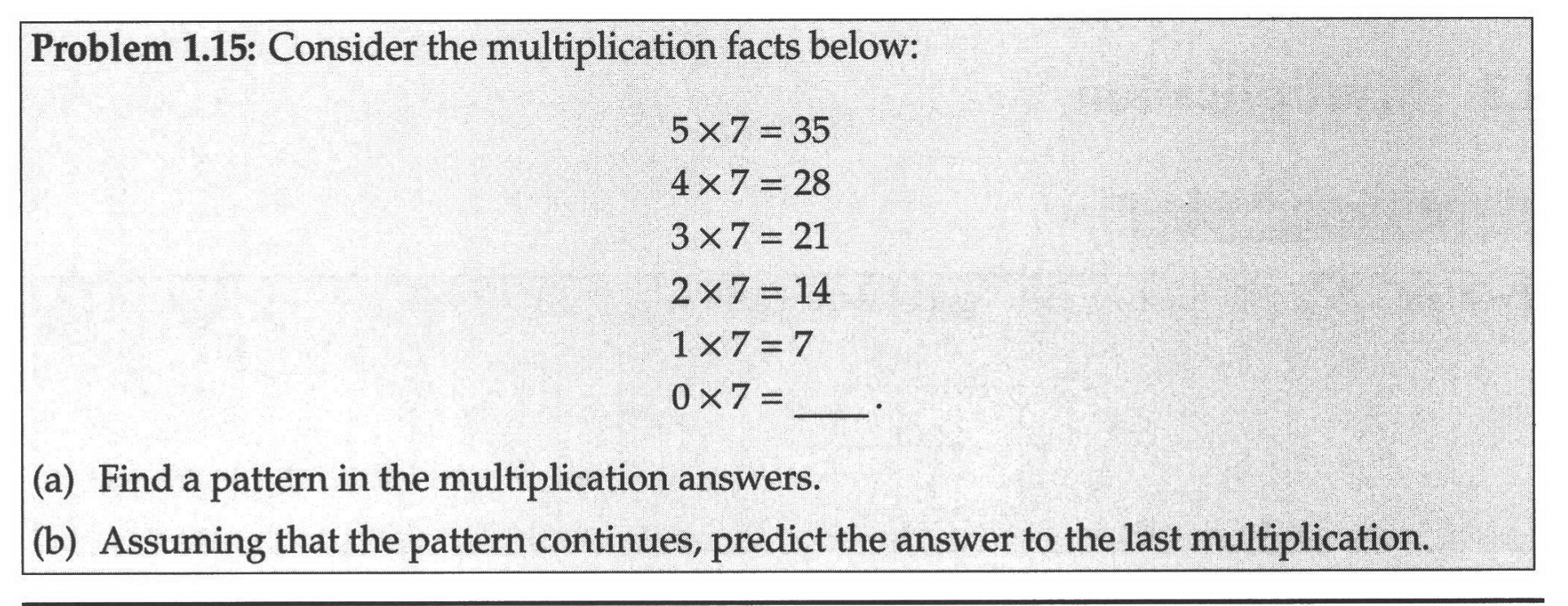
a) Each subsequent line is 7 less than the previous.
b) 0.
Exercises
✅ 1.3.1

We can multiply the 25 and the 4 first to get 100.
We can then multiply the 17 and the 20 to get 340.
We can multiply 100 and 340 to get the answer, 34000.
✅ 1.3.2

We can use the principle of the associative property to group things together as we like.
The result is
$100 * 100 * 100 * 100$
The answer is 100,000,000.
✅ 1.3.3

There are 5 sets of $2 \cdot 5$, or 5 10's.
The answer is thus 100,000.
✅ 1.3.4

This is just 1995.
✅ 1.3.5

The 1's don't matter to the result, so this is just $5 \cdot 5 \cdot 5$, or 125.
✅ 1.3.6

a)
$11 \cdot (43 + 57)$
$11 \cdot 100$
Answer is 1100.
b)
$6 \cdot (22 + 38)$
$6 \cdot 60$
Answer: 360.
c)
$16 \cdot (32 + 48)$
$16 \cdot 80$
The answer is 1280.
✅ 1.3.7

if a = 2, b = 3, and c = 4, then:
$a + (b \cdot c) = 2 + (3 \cdot 4) = 2 + 12 = 14$
$(a + b)\cdot(a + c) = (2 + 3) \cdot (2 + 4) = 5 \cdot 6 = 30$
Therefore $a + (b \cdot c) ≠ (a + b)\cdot(a + c)$
✅ 1.3.8

$456 \cdot (1 + 1 + 1 + 1 + 1 + 1 + 1 + 1 + 1 + 1)$
$456 \cdot 10$
The answer is 4560.
✅ 1.3.9

0, cuz of the rule of multiplying by 0.
✅ 1.3.10

The middle term - $110 \cdot 0 \cdot 101$ - "drops out" cuz of the 0. So we're left with 10 + 111, which gives an answer of 121.
Una primera decisión consiste en concretar el tipo de corte que resulta más cómodo. La decisión gana claridad cuando se puede comprobar la información disponible sobre reposición o disponibilidad. Consultar «» ayuda a examinar las diferencias entre opciones relacionadas. Antes de dar por cerrada la búsqueda, es recomendable comprobar el color y el diseño seleccionados.