AOPS Pre-Algebra Chapter 1.1 & 1.2 Notes & Exercises
Table of Contents
I'm going through this book and taking notes/doing the problems.
Chapter 1.1 - Why Start With Arithmetic?
Goal of chapter is to help you understand why arithmetic calculations work instead of just following calculations. With that understanding, you'll be better able to do algebra.
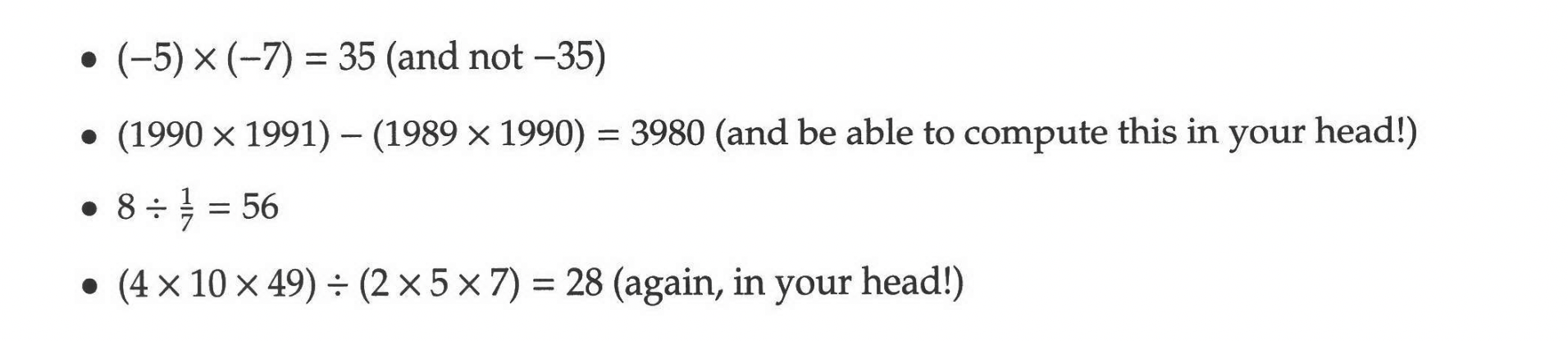
Should be able to explain why the following computations are true at end:
The number line goes on forever in both directions:

Positive numbers are to the right of 0 on the number line. Negative numbers are to the left of 0. Nonnegative numbers are either positive or 0. Nonpositive numbers are either negative or 0.
There's some debate about the meaning of terms like whole number and natural number. The book sidesteps that debate by using less ambiguous terms.
Chapter 1.2 - Addition
Key Points
The rule that $a + b = b + a$ for all numbers b and a is called the commutative property of addition.
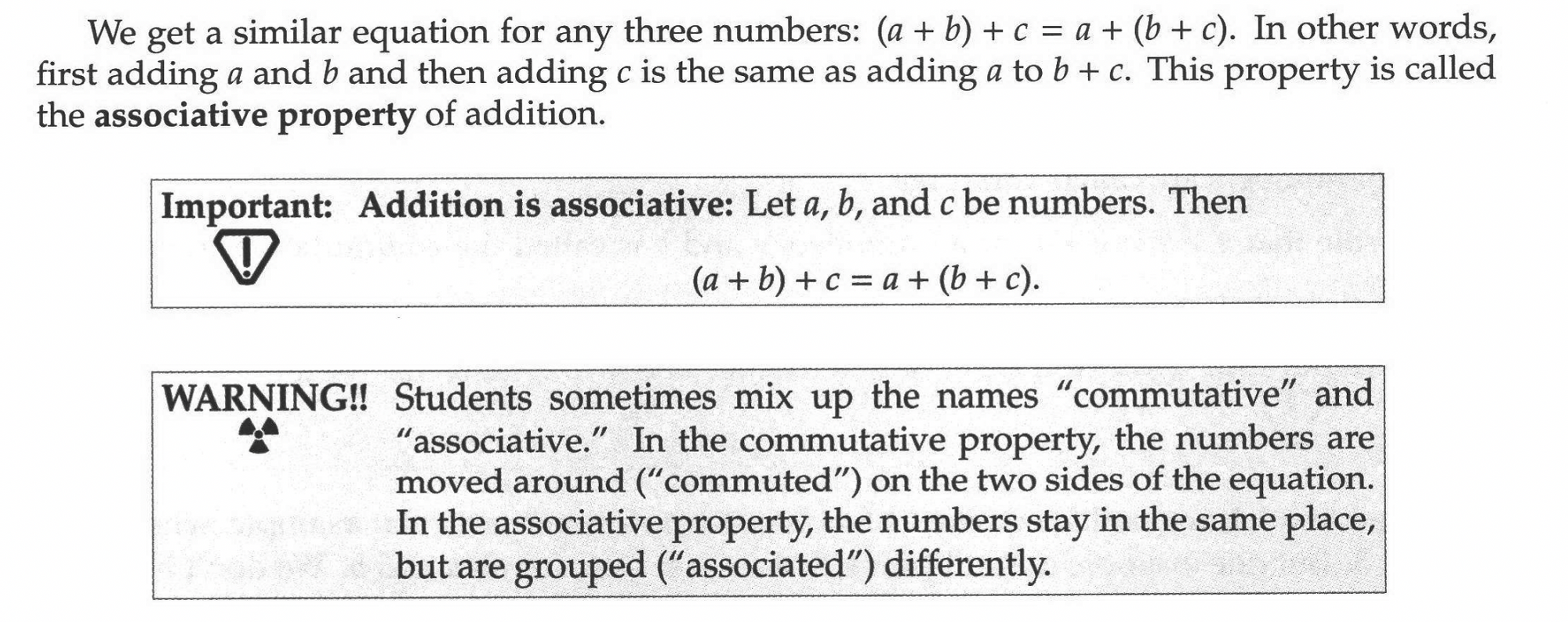
The rule that says that $(a + b) + c = a + (b + c)$ is the associative property of addition.
Adding zero doesn't change a number. $a + 0 = a$
In-Chapter Problems
Problem 1.1 - Commutative Property

My explanation: if you think of the numbers as representing some number of squares, it does not matter to the final result what order you add up the squares in. Whether you add 2 squares plus 3 squares or 3 squares plus 2 squares, the result is 5 squares. The pictures are the same basic shape, consisting of 5 squares, except that you can think of one of the shapes as having been flipped upside down in relation to the other one.
IIRC this illustrates the commutative property.
Their explanation: agrees with mine. They abstract it and define the commutative property.

Problem 1.2 - Associative Property
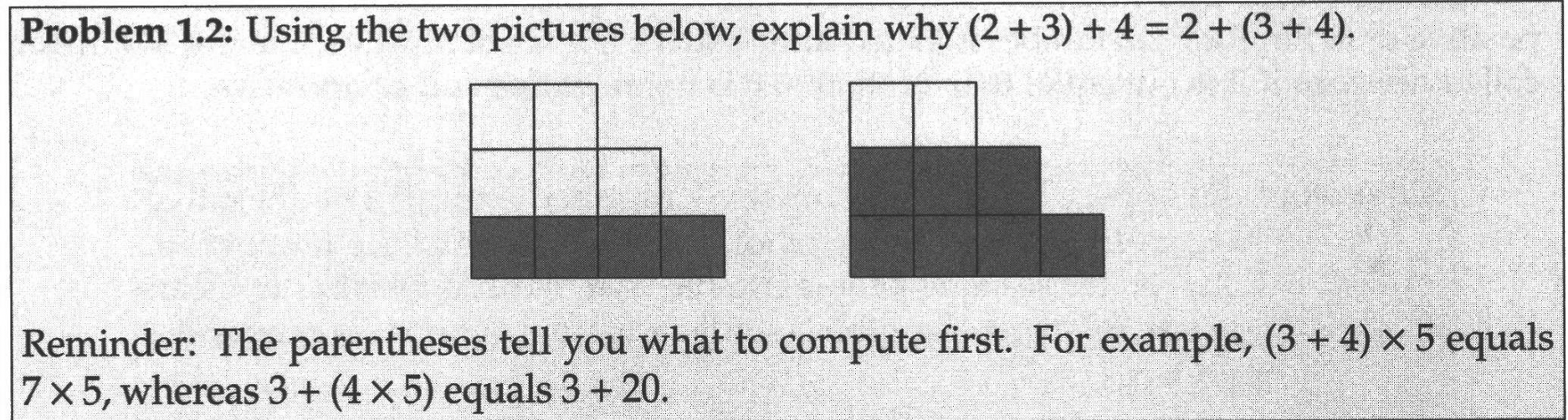
My explanation: it doesn't matter to the result if we group the 2 and the 3 together, add them, and then add 4, or if we group the 3 and the 4 together, add them, and then add 2. We are just adding things and so we have the same number of squares or apples or whatever at the end of the day regardless of the order we add things up in.
IIRC this illustrates the associative property.
Their explanation connects the groupings specifically to the light and dark squares, which I was doing mentally but did not write out. They also define the associative property which the problem illustrates and give a helpful way of remembering the terminology.
Problem 1.3 - Any-Order Principle
My explanation:
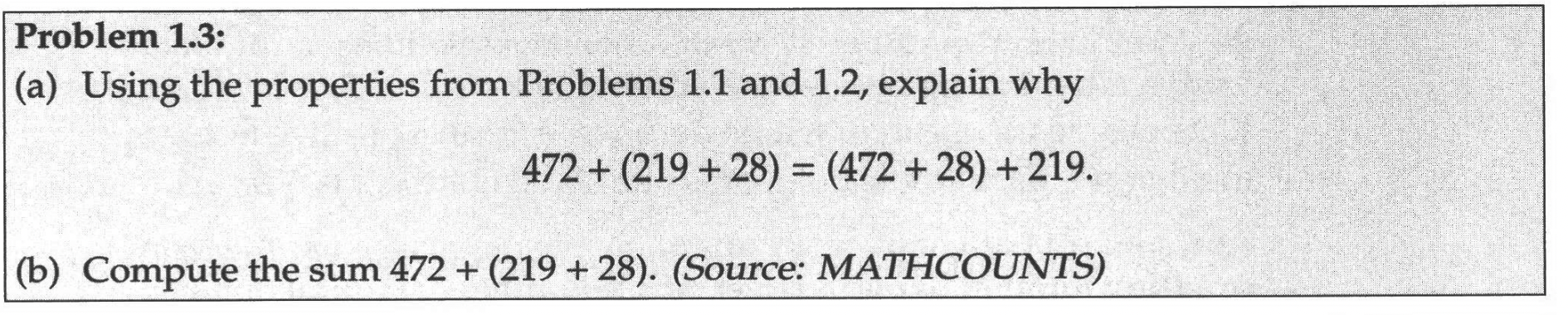
a) You can change both the order and the grouping when adding some numbers together and it won't affect the result.
b) 719
(I rearranged the grouping so that I added 472 + 28 first, to get 500, and then the rest was easy).
Their explanation:
a)
Initial state: $472 + (219 + 28)$
Commutative property: $472 + (28 + 219)$
Associative property: $(472 + 28) + 219$
b) They agree.
Problem 1.4

My explanation:
160 (add up 2 + 38, 12 + 28 and so on, getting 4 40's).
They agreed.
Problem 1.5

210.
My explanation:
Add up 1 + 20, 2 + 19, and so on. 10 such pairs, so 21 *10.
Another way of doing it: 1 + 19, 2 + 18, and so on. 9 such pairs, so you get 180 from that. Then when you get to 10 + 20, the sum is 30 instead of 20, so the total is 210. I like the previous way better, cuz there isn't a special case.
They did my first method.
Problem 1.6

My explanation: If you add nothing to any number of boxes or apples or whatever, you still have the same number of boxes or apples as before.
End of Chapter Exercises
1.2.1

My explanation:
By the principle of the commutative property we can rearrange the values: $99 + 101 + 99 + 101 + 99 + 101$
By the associative property we can change the grouping of the values: $(99 + 100) + (99 + 100) + (99 + 100)$
$200 + 200 + 200$ = 600
So the answer is 600.
1.2.2

$(1999 + 2001) + (1999 + 2001) + (1999 + 2001) + (1999 + 2001) $
So the answer is 16000.
1.2.3

We find a useful grouping: where every group sums to 50 $(3 + 47) + (13 + 37) + (23 + 27) + (33 + 17) + (43 + 7)$
There are five such groups, so the answer is 250.
Para reducir opciones desde el principio, es útil establecer la finalidad de uso diario, deportivo o de colección. Antes de descartar un modelo, merece la pena distinguir las imágenes de muestra de las fotografías del producto. Entre los recursos de apoyo, «camisetas futboleras» facilita la tarea de comprobar si los resultados responden al objetivo planteado. En la fase final, es recomendable verificar que el corte encaje con el uso previsto.
1.2.4

We can group (1 + 99), (2 + 98) and so on. Each grouping totals to 100. There are 50 such groupings. So the answer is 5000.